Published by LifeSavers United | lifesaversunited.org
👋 A Message Before We Begin
If you are someone who donates platelets regularly, first of all, thank you. Single Donor Platelet donation, which most people in India know as SDP donation, is one of the most generous and impactful things a person can do. The platelets you donate go directly to cancer patients, thalassemia children, accident victims, and people undergoing major surgeries. Your contribution is not just a medical procedure. It is a lifeline for real people and real families.
But because you donate regularly and because platelet donation works differently from whole blood donation, your body deserves extra attention and care. One of the most important ways to protect your health as a regular SDP donor is through a simple but significant test called the Serum Protein Test.
This blog is written for you. It explains what this test is, why it matters, and how it fits into your journey as a responsible and healthy platelet donor in India.
💉 What Is SDP Donation and Why Is It Different
Before we understand the serum protein test, it helps to understand what makes SDP donation unique.
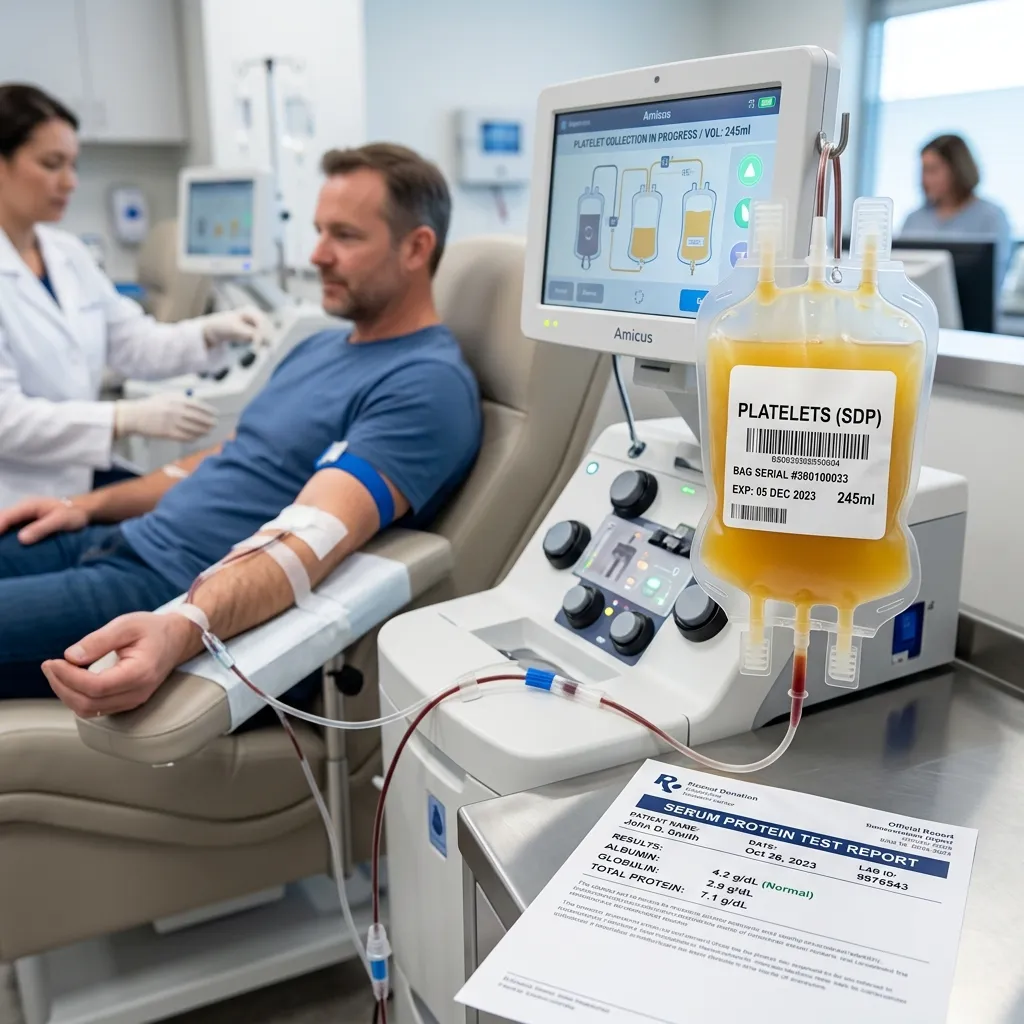
Single Donor Platelet donation is a process called apheresis. During this procedure, blood is drawn from your arm, passed through a special machine that separates out only the platelets, and then the remaining components including red blood cells and plasma are returned to your body. The entire process takes about 60 to 90 minutes and is done at apheresis centres in hospitals and blood banks across India.
Because only platelets are removed and the rest of the blood is returned, SDP donation is considered safer in many ways than whole blood donation. It also means that a healthy person can donate platelets more frequently, usually once every two to four weeks, depending on the guidelines followed by the blood bank.
However, this frequency comes with a responsibility. Because you are donating more often, your body needs to consistently recover well. And that recovery depends significantly on your protein levels.
🔬 What Is a Serum Protein Test
A serum protein test is a blood test that measures the total amount of protein present in the liquid part of your blood, which is called serum. It primarily measures two key proteins: albumin and globulin. Together, these are reported as total serum protein.
Proteins in your blood are not just numbers on a lab report. They perform essential functions in your body. They help carry nutrients and hormones. They support your immune system. They regulate fluid balance between your blood vessels and tissues. They assist in clotting. And importantly, they help your body recover after procedures like platelet donation.
Normal total serum protein levels in adults are generally between 6.0 and 8.3 grams per decilitre, though individual blood banks and hospitals in India may use slightly varying reference ranges based on their laboratory standards.
For a regular SDP donor, the serum protein test is a way of checking that your body is maintaining these levels adequately despite the frequency of donation.
🛡️ Why Regular SDP Donors Need This Test
Here is something that many donors do not fully realise. When you donate platelets, small amounts of plasma proteins are also removed along with the platelets during the apheresis process. Modern apheresis machines used in India are designed to minimise this, but over time and with repeated donations, there can be a gradual impact on your protein levels if your diet and recovery are not adequate.
A person who donates platelets once and never again faces a very different physiological situation from someone who donates every three to four weeks throughout the year. The regular donor's body is continuously asked to replenish what has been taken. If protein intake or absorption is insufficient, levels can slowly drop without the donor even noticing.
Low protein levels, a condition called hypoproteinemia, can cause fatigue, reduced immunity, slow healing, fluid retention, and a general decline in physical wellbeing. In more significant cases it can affect organ function. None of these outcomes are what anyone wants for a person who is voluntarily giving their time and health to save others.
The serum protein test is simply a way of making sure your body is keeping up. It is a check in, a health safeguard, and a way for the blood bank and medical team to catch any decline early before it becomes a problem.
🇮🇳 What Indian Blood Bank Guidelines Say
Blood banks and apheresis centres in India operate under the guidelines set by the Drugs and Cosmetic Act, the National Blood Transfusion Council, and the standards maintained by the National AIDS Control Organisation. Many leading hospitals also follow international standards from organisations like the AABB and WHO as a reference.
Under these frameworks, regular SDP donors are expected to meet certain eligibility criteria before each donation. Total serum protein is one of the parameters checked to confirm donor fitness. Most centres in India require a minimum total serum protein level of 6.0 g/dL or above before allowing a donor to proceed with apheresis.
In practice, the approach varies across centres. Some hospitals check serum protein before every donation session. Others conduct it at regular intervals, such as every three months for donors who donate frequently. Some centres test it only when a donor reports symptoms or when routine haematological values raise a concern.
The important point is that this test is not optional or bureaucratic. It exists because donor safety is a medical and ethical priority for every responsible blood bank in India.
📖 Real Situations from Indian Apheresis Centres
Let us look at some everyday scenarios that help illustrate why this test matters.
The Case of Ramesh, Hyderabad
Consider Ramesh, a 34 year old IT professional from Hyderabad who has been donating platelets regularly for the past two years. He donates once every three to four weeks and has always been told he is a healthy donor. But over the past few months he has been feeling unusually tired, and his concentration at work has dropped. When his blood bank runs a serum protein test before his next donation, they find his albumin level has dropped below normal range. A closer look revealed that his diet had become irregular due to work stress, and his protein intake was insufficient to support his donation schedule. The blood bank advises him to pause donation for six weeks, improve his diet, and return for a retest. Ramesh recovers, his levels normalise, and he resumes donation safely.
Priya's Journey, Pune
Now consider Priya, a 28 year old schoolteacher from Pune who donates platelets to support a childhood friend undergoing cancer treatment. She donates once a month and is diligent about her diet and sleep. Her serum protein levels consistently fall within the healthy range at every check. For Priya, the serum protein test is reassurance. It tells her that her body is managing well and that she can continue to help her friend and others like him without compromising her own health.
Both stories reflect what happens in apheresis centres every week across cities like Delhi, Mumbai, Chennai, Bengaluru, Kolkata, Ahmedabad, and beyond. The test is not about discouraging donation. It is about making sure donation remains sustainable and safe for the long term.
🔄 How Frequent Platelet Donation Affects Protein Levels
To understand this more clearly, let us think about what happens in your body with repeated donations.
Each time you undergo apheresis, your body enters a mild recovery state. It needs to replenish the platelets that have been removed, restore the small amount of plasma proteins that accompany the process, and stabilise its internal fluid and electrolyte balance. For most healthy donors, this recovery happens within 48 to 72 hours for platelets, and a bit longer for full protein restoration.
If you donate again before this recovery is complete, or if your nutritional intake is not supporting recovery, the cumulative effect can be a slow downward drift in protein levels. This is not dramatic or sudden. It is gradual. And that is exactly why it can go unnoticed without testing.
Factors that make Indian donors more vulnerable to this include irregular meal patterns, a predominantly low protein vegetarian diet without adequate compensation, high physical activity or labour intensive occupations, periods of illness or infection between donations, and economic or lifestyle constraints that affect nutrition quality.
None of these are reasons to stop donating. They are reasons to monitor more carefully and support the donor with guidance and education.
🍛 Proteins, Platelet Donation, and the Indian Diet
India is a country of immense dietary diversity, and the nutritional needs of a regular SDP donor need to be understood in the context of what most people actually eat.
A significant proportion of donors across India are vegetarian. While a well planned vegetarian diet can absolutely provide adequate protein, many people do not consume enough protein rich foods consistently. Dal, paneer, curd, milk, rajma, chana, moong, soybean, and nuts are all excellent protein sources available across India. But portion sizes, cooking methods, and regularity of consumption vary widely.
Non vegetarian donors have access to eggs, chicken, fish, and mutton, which are high quality complete protein sources. However, affordability, personal preferences, and availability can affect intake.
When a blood bank conducts a serum protein test and finds a donor's levels are borderline or below normal, the follow up conversation often includes dietary counselling. A clinical nutritionist or the blood bank's medical officer may advise on increasing protein intake through food, sometimes with specific guidance on meal planning suitable for the donor's region, religion, and budget.
This is one of the quieter but genuinely important ways that blood banks in India look after their donors. It is healthcare that goes beyond the donation itself.
⚠️ Signs That Your Protein Levels May Need Attention
Your body often gives signals before a test confirms anything. As a regular SDP donor, it is worth paying attention to these signs and discussing them honestly with the medical team at your apheresis centre.
Persistent fatigue that is not explained by lack of sleep or overwork can be an early sign. Feeling unusually weak or finding that your recovery after donation takes longer than before is worth noting. Swelling or puffiness around the face, ankles, or feet, which can indicate fluid imbalance related to low albumin, is something to bring up with your doctor. Frequent infections or slower healing of minor wounds may point to reduced immune proteins.
None of these symptoms automatically mean your protein levels are low. But they are signals worth investigating. And the serum protein test is exactly the right starting point.
The most important thing is not to hide these symptoms or feel embarrassed about them. The medical team at your blood bank wants to know. They are there to help you stay healthy, not to turn you away.
🩺 How the Serum Protein Test Is Done
The test itself is straightforward and familiar. A small sample of blood is drawn from your vein, usually from the arm. The sample is sent to the laboratory where it is processed to measure total protein, albumin, and globulin levels. Results are typically available within a few hours to one day depending on the laboratory setup.
In most apheresis centres attached to large hospitals in India, the test is done in house. In smaller standalone blood banks, it may be sent to an affiliated laboratory. The cost is minimal and in many cases is covered as part of the pre donation screening process.
You do not need to fast before a standard serum protein test in most situations, though your blood bank may give you specific instructions depending on whether other tests are being done at the same time. Once results are available, the medical officer at the blood bank will review them alongside your other health parameters and advise accordingly. If your levels are within normal range, you proceed with donation as planned. If they are borderline or below normal, the doctor will guide you on next steps, which may include a temporary pause in donation, dietary changes, or referral for further evaluation if needed.
📍 Where Can You Get the Serum Protein Test Done
One of the most reassuring things about this test is how accessible it is. You do not need a referral, a specialist, or a long wait. The total serum protein test is a standard blood test available at hundreds of labs, diagnostic chains, and online booking platforms across India. Here is a practical guide to your options, whether you are in Ahmedabad, a metro city, or a smaller town.
Option 1: At your blood bank or apheresis centre
This is always the first place to ask. Most apheresis centres attached to hospitals run pre-donation blood work in house. The serum protein test is typically part of or can be added to your regular donor health screening. In most cases it costs you nothing, as it is covered under the donation process. Before your next session, simply ask the medical officer: "When was my serum protein last checked?" If it has been more than three months, request it on the spot.
Option 2: Major diagnostic laboratory chains
For donors who want an independent check between donation visits, several trusted, NABL and CAP accredited chains offer this test across India with walk-in and home collection options.
- Metropolis Healthcare is one of the most widely available options for donors in Gujarat and across India. The price of the Total Proteins Test (Serum) at Metropolis in Ahmedabad is ₹170, making it genuinely affordable. Metropolis provides home sample collection in Ahmedabad, with reports typically available on the same day once the sample reaches the lab. Reports can be received via email, WhatsApp, or the Metropolis app. Metropolis has labs and collection centres across Mumbai (₹300), Pune, Chennai, Bengaluru, Delhi, and many Tier 2 cities.
- Thyrocare is another widely trusted pan-India option, especially known for affordable pricing. Thyrocare lists the Total Protein test at ₹231 and operates across Delhi, Hyderabad, Bengaluru, Kolkata, Mumbai, Pune, and Chennai. Thyrocare works primarily through a network of collection agents who visit your home, making it a largely home-collection-first service.
- Dr. Lal PathLabs is one of India's oldest and most trusted diagnostic chains with over 5,500 collection centres and 280 labs nationwide. It is well represented across metros and many Tier 2 cities. Pricing for the total protein serum test varies by city, with Delhi and Mumbai priced slightly higher than smaller cities. Expect to pay in the ₹150 to ₹300 range for the standalone test. Home collection is available nationwide and online discounts are available when booking through the Dr. Lal PathLabs app.
- Sterling Accuris Diagnostics is the most important chain for donors in Gujarat specifically. Sterling Accuris is one of the fastest growing NABL accredited pathology lab chains in India, with a particularly strong presence in Gujarat, Rajasthan, and Madhya Pradesh, and more than 250 collection centres and labs. Their NABL accredited reference laboratories are located in Ahmedabad, Vadodara, Surat, Jamnagar, Bhavnagar, and Mehsana, among other Gujarat cities. For donors in Ahmedabad, Surat, Vadodara, Rajkot, Gandhinagar, Bharuch, Bhuj, Mehsana, Palanpur, or smaller towns like Anand, Deesa, and Himmatnagar, Sterling Accuris is often the most locally accessible NABL certified lab. You can call them on 812 813 0000 or book through their website sterlingaccuris.com to confirm test availability and pricing at your nearest centre.
- SRL Diagnostics and Apollo Diagnostics are additional reliable options available across metros and major cities. Apollo also operates Apollo 24|7, an app-based platform that includes home sample collection. Apollo 24|7 provides home blood sample collection in Ahmedabad with a straightforward online booking process through their app or website.
Option 3: Online health platforms with home sample collection
If walking into a lab is inconvenient or you prefer to get tested from home, these platforms connect you with certified collection agents who come to your doorstep:
- Tata 1mg Labs (www.1mg.com) allows you to search for "Protein Total Serum," select your city, and book a time slot. A trained phlebotomist visits your home, and reports are delivered digitally. Available across most metros and major cities.
- Healthians (www.healthians.com) is available in Ahmedabad and other Gujarat cities including Surat and Vadodara, with transparent pricing and home collection. They also offer free doctor consultation with reports.
- Redcliffe Labs (www.redcliffelabs.com) has expanded actively into Gujarat cities including Ahmedabad, with home collection and digital reports. Redcliffe Labs offers free home sample collection with 100% accurate reports and a free doctor consultation alongside test results.
- Platforms like Practo and Healthians also partner with certified labs and offer competitive pricing along with doorstep sample collection.
When booking on any of these platforms, search for "Total Protein Serum" or "Protein Total Serum." Do not confuse it with "Serum Protein Electrophoresis," which is a different and more specialised test not required for routine donor monitoring.
💰 How Much Does the Test Cost
This test is genuinely affordable. Here is a city-wise and lab-wise breakdown based on current pricing:
| Lab / Platform | Ahmedabad | Mumbai | Delhi | Other cities |
|---|---|---|---|---|
| Metropolis Healthcare | ₹170 | ₹300 | ₹200–₹280 | ₹150–₹300 |
| Thyrocare | ~₹231 | ~₹231 | ~₹231 | ~₹231 (uniform) |
| Dr. Lal PathLabs | ₹150–₹200 | ₹200–₹300 | ₹200–₹300 | ₹150–₹250 |
| Sterling Accuris | Call 812 813 0000 | — | — | Competitive, Gujarat-wide |
| 1mg / Healthians / Redcliffe | ₹150–₹250 | ₹200–₹300 | ₹150–₹280 | Varies |
At your apheresis centre or blood bank, the test is often free, covered as part of donor screening. If you are getting tested independently outside of a donation visit, budget between ₹150 and ₹300 at any reputable NABL accredited lab. Smaller local labs may charge even less but always ensure they are accredited.
Note: Prices are indicative as of 2025 and may vary by city and lab branch. Please confirm current pricing when booking.
⏱️ How Long Does It Take to Get Your Results
The total serum protein test is a fast, automated, routine test. Here is what to expect:
- At your blood bank or hospital lab on donation day, results are usually ready within 2 to 4 hours, often before you leave the centre.
- At a walk-in diagnostic chain like Metropolis, Sterling Accuris, or SRL, reports are typically available on the same day once the sample reaches the laboratory.
- For home collection bookings through Thyrocare, 1mg, Healthians, or Redcliffe, a trained phlebotomist typically collects your sample in the morning, and reports are delivered within 24 to 48 hours via SMS and email, though for a standard total protein test, same-day results are common at most centres.
There is no dramatic wait or uncertainty involved. This is a simple, high-volume, automated test that modern labs process quickly. You do not need to take a day off or plan around it.
❓ Addressing Common Concerns of Regular SDP Donors
Will I be disqualified from donating forever if my protein levels drop?
Almost always, no. A temporary deferral is a pause, not a permanent exclusion. With proper nutrition and rest, protein levels typically recover within a few weeks. Most donors who are deferred due to low protein return to regular donation after following the recommended dietary and recovery plan.
Should I take protein supplements?
This is a question many donors ask, especially younger donors who are health and fitness conscious. The honest answer is that food based protein is almost always preferred and sufficient for most donors. Supplements may be recommended in specific cases by the doctor, but self medicating with protein powders without medical guidance is not advisable. Focus on a balanced diet rich in natural protein sources first.
How often should I get this test done?
This depends on how frequently you donate and what your blood bank's protocol is. If you donate once a month or more, most responsible apheresis centres will check serum protein at least every three to six months. If you are donating less frequently, it may be checked periodically or whenever a clinical need arises. Ask your blood bank directly about their protocol so you are informed.
Is this test required by law in India?
Indian regulatory guidelines mandate certain pre donation checks. The specific frequency and scope of serum protein testing may vary, but reputable blood banks and apheresis centres include it as a standard part of caring for regular donors. If your centre does not check it regularly, it is entirely appropriate to request it or ask why.
🤝 The Responsibility of Blood Banks Towards Donors
It is easy to focus on what donors give. But responsible blood banking is a two way relationship. Just as donors give their time, health, and commitment, blood banks and apheresis centres have a duty of care toward every person who walks through their door.
This duty includes thorough pre donation screening, honest communication about test results, respectful counselling when levels are not adequate, follow up after a deferral period, and creating an environment where donors feel safe to share health concerns without fear of being judged or turned away.
In India, the best blood banks and apheresis centres already do this. They treat their regular donors like extended family. They know their names, know their histories, and genuinely care about their wellbeing beyond the donation session.
LifeSavers United stands firmly behind this model of donor care. A donor who is healthy, informed, and supported will donate safely for years. A donor who is neglected or ill informed may face health consequences that no one wanted. Building a culture of mutual responsibility between donors and healthcare providers is central to a sustainable blood donation ecosystem in India.
🥗 Nutrition Tips for Regular SDP Donors in India
While dietary advice should always be personalised and given by a qualified professional, here are some general principles that most healthcare educators recommend for regular platelet donors in India.
- Include a good protein source in every main meal. This could be dal and curd together, paneer with vegetables, eggs in any preparation, chicken or fish for non vegetarians, or a combination of legumes and whole grains that together provide complete protein.
- Do not skip meals, especially on donation days and the day before. Your body needs nourishment to prepare for the donation and to recover afterwards.
- Stay well hydrated. Water and fluids support circulation, make the apheresis process smoother, and support overall recovery.
- Include iron rich foods alongside protein foods, since many donors need to support both haemoglobin and protein levels simultaneously. Spinach, methi, horsegram, and fortified foods are helpful here.
- Rest adequately after donation. Physical recovery and nutritional recovery go hand in hand. Avoid strenuous physical activity on the day of donation.
- If you have specific dietary restrictions due to health conditions, allergies, or personal beliefs, talk to the medical officer at your blood bank. There is almost always a practical and culturally appropriate way to meet your nutritional needs.
❤️ Why This Matters to LifeSavers United
At LifeSavers United, we believe that saving lives cannot come at the cost of the person who is doing the saving. Our donors are not just a supply of platelets. They are community heroes who deserve full information, genuine care, and ongoing support.
The serum protein test is one small but meaningful piece of that larger commitment to donor health. It is a test that says we value you, we are watching over your health, and we want you to keep giving safely for as long as you choose to.
Our work across India involves not just encouraging donation but educating donors about their rights and responsibilities, supporting blood banks in strengthening their donor care practices, and raising public awareness about what responsible platelet donation looks like.
When a regular SDP donor in Nagpur or Kochi or Jaipur knows what a serum protein test is and why it matters, they are a more informed and empowered donor. And informed donors are the foundation of a strong, safe, and sustainable blood donation system.
📢 A Gentle Call to Action
If you are a regular SDP donor, please ask your apheresis centre when your serum protein was last checked. If it has been a while, request the test at your next visit. Take your diet seriously, not just on donation days but every day.
If you are someone who has been thinking about starting platelet donation, know that responsible blood banks in India take your health seriously and have processes in place to protect you every step of the way.
And if you work in a blood bank, apheresis centre, or hospital setting, we encourage you to make serum protein testing a consistent and transparent part of your regular donor care protocol. It is a small investment that protects your donors and builds lasting trust.
Visit lifesaversunited.org to learn more about safe donation practices, donor health resources, and how LifeSavers United is working to strengthen platelet donation awareness across India. Share this blog with a fellow donor, a blood bank volunteer, or anyone in your community who might benefit from this information.
Your health matters. Your donation matters. And together, we can make sure that giving life never costs you yours.
📝 In Summary
The serum protein test is a straightforward and essential health check for anyone who donates platelets regularly in India. It measures the total protein in your blood and ensures that your body is coping well with the demands of frequent donation. For regular SDP donors, this test is a safeguard, a health monitor, and a sign that the blood bank genuinely cares about the person behind the donation.
Getting tested regularly, eating well, staying hydrated, and communicating openly with your medical team are the four pillars of long term healthy donation. When these are in place, you can continue to be the lifesavers that so many patients in India are counting on.
Thank you for what you do. Stay healthy. Keep giving.
Sources & References:
Drugs and Cosmetics Act (India) | National Blood Transfusion Council (NBTC) | NACO Blood Safety Division | AABB Technical Manual | World Health Organization (WHO) Donor Selection Criteria | Metropolis Healthcare Pricing (2025) | Sterling Accuris Diagnostics | Dr. Lal PathLabs.