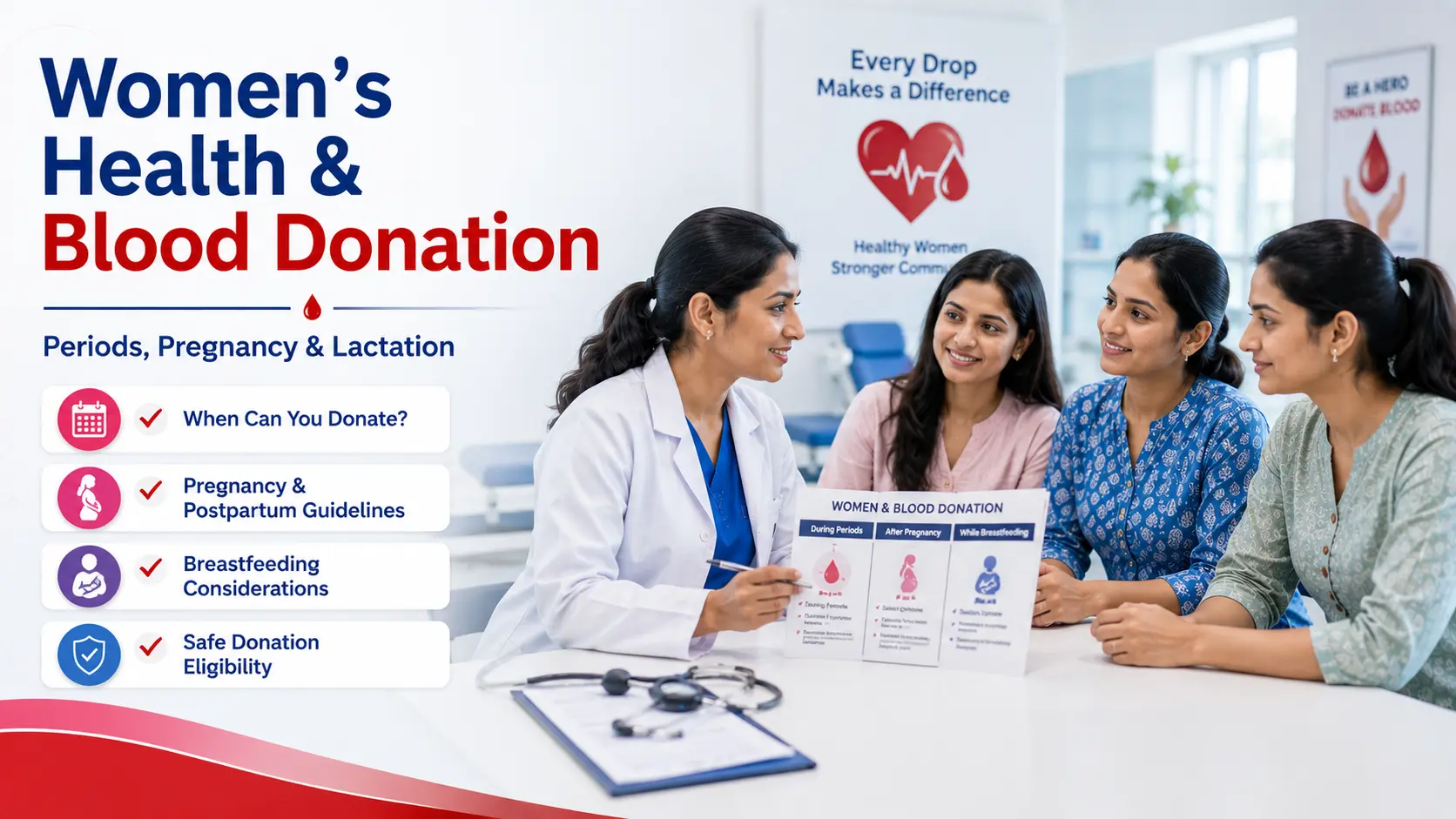
Despite constituting over 48% of India's population, female blood donors account for less than 10% of voluntary blood donations nationwide. Widespread myths—such as believing that women cannot donate during periods, or that blood donation causes permanent weakness—continue to hold prospective female donors back. Under the February 2025 DGHS & National Blood Transfusion Council (NBTC) guidelines, female donors are warmly encouraged to donate provided specific reproductive health safeguards are respected.
Female physiology undergoes distinct biological phases: monthly menstrual cycles, pregnancy, childbirth, lactation, and hormonal fluctuations. The 2025 DGHS guidelines establish clear medical boundaries designed to protect maternal iron stores while enabling healthy women to become life-saving voluntary donors.
🩸 1. Can You Donate Blood During Periods (Menstruation)?
Under of the 2025 DGHS Guidelines, menstruation is addressed with practical clinical common sense:
The 2025 Official Stance:
- Normal Menstrual Cycle: If a female donor feels active, energetic, and is experiencing normal flow without severe cramping or pain, she IS ELIGIBLE TO DONATE BLOOD provided her Hemoglobin is ≥ 12.5 g/dL.
- Heavy Flow / Menorrhagia: If experiencing heavy bleeding, severe abdominal pain, dysmenorrhea, or general malaise, the Medical Officer will defer donation until the period ends and full energy is restored.
🤰 2. Pregnancy, Lactation & Postpartum Deferral Table
Reproductive events require substantial iron and blood plasma expansion to nourish the developing fetus and breastfed infant (- 18 of 2025 Guidelines):
| Reproductive Phase | Biological Rationale | 2025 DGHS Deferral Rule |
|---|---|---|
| Active Pregnancy | Maternal blood volume expands by 40-50% to supply placental blood flow. Withdrawing 350mL causes maternal hypotension and fetal hypoxia. | DEFERRED throughout full pregnancy term |
| Postpartum (Post Delivery) | Rebuilding maternal hemoglobin and ferritin stores post-delivery blood loss. | Defer 12 Months (1 Year) post-delivery |
| Breastfeeding / Lactation | Breast milk production requires significant maternal calcium, protein, and fluid output. | Defer 12 Months post-delivery & during active lactation |
| Abortion or Miscarriage | Allowing uterine lining recovery and replenishment of lost blood volume. | Defer 6 Months post-abortion |
⏱️ 3. Why the Female Donation Interval is 4 Months (120 Days)
Under of the 2025 DGHS Guidelines:
Male Donors
Interval: Once every 3 months (90 days).
Maximum 4 times per year. Men have higher baseline testosterone levels and no monthly
physiological blood loss, enabling faster red cell regeneration.
Female Donors
Interval: Once every 4 months (120 days).
Maximum 3 times per year. The additional 30 days allow female donors to fully replenish
bone marrow iron reserves (serum ferritin) lost during menses.
💪 4. Hemoglobin Screening & Boosting Iron Health
Every prospective donor in India must achieve a minimum Hemoglobin (Hb) level of 12.5 g/dL . Blood centers test Hb using the Copper Sulphate (CuSO4) specific gravity drop method or HemoCue digital photometers prior to donation.
Indian Diet Tips to Boost Hemoglobin above 12.5 g/dL:
- Iron-Rich Foods: Spinach (Palak), fenugreek (Methi), beetroot, dates (Khajoor), jaggery (Gud), raisins, and dark leafy greens.
- Vitamin C Synergy: Combine iron sources with Vitamin C rich foods (Amla, lemon water, oranges, tomatoes) to double intestinal iron absorption.
- Avoid Inhibitors: Do not consume tea, coffee, or milk within 1 hour after meals, as tannins and calcium inhibit dietary iron absorption.
❓ 5. Frequently Asked Questions (FAQs)
Q1: Can I donate blood if I have PCOS / PCOD?
Yes. Donors with Polycystic Ovarian Syndrome (PCOS/PCOD) are eligible to donate blood provided they feel well on the day of donation and their routine medications (like Metformin or oral contraceptives) are approved under the 2025 medication guidelines .
Q2: Why must I wait 12 months after giving birth before donating blood?
Pregnancy and childbirth consume substantial body iron. The 12-month waiting period ensures maternal bone marrow has completely restored ferritin stores and red blood cell count post-delivery.
Q3: Does donating blood cause weight loss or weakness in women?
No! Donating 350 mL of blood removes only about 8-10% of your total blood volume, which your body's bone marrow and liver replenish within 24 to 48 hours without affecting body weight or physical strength.
Explore Complete 2025 Guideline Resources
Read our sub-blogs on tattoo waiting times, chronic illness eligibility, medication charts, and blood screening recall protocols.